
Get inspired, get aware, and act fast.
Localization has changed a lot since AI became part of everyday localization workflows. Content has multiplied, formats have expanded, and AI is now part of everyday workflows, so localization specialists need to understand how to use it properly.
We’ve collected the key localization trends for 2026, based on industry insights and our own observations, and added practical ideas on what you can start doing right away.
Trend 1. Multimodal Localization Expands
In 2026, localization is not limited to text.
UI copy, onboarding screens, product demos, videos, animations, and social media content have all been part of the localization scope for years. What has changed is the volume and speed at which this content is now created and released.
In 2026, AI helps process large content volumes across different formats, and humans should ensure the message still feels natural and culturally correct.
What you can do right away:
List all content formats you publish — text, video, visuals, audio — and check which ones can be included in your localization process.
Trend 2. Personalization in Localization
One of the clearest trends shaping localization today is deeper personalization. More products now adapt language based on who the user is, not just where they are. A developer, a marketer, and an executive may see different texts inside the same product, even if they live in the same country and use the same language.
For example, Booking.com adapts content based on user intent, travel context, and behavior.

This shift changes the role of localization. It moves closer to UX, product design, and user journeys, and further away from one-size-fits-all translation. It starts meaning supporting different user experiences inside the same language.
What you can start using right away:
Work with product and UX teams to identify where role-based or behavior-based language already exists — and make sure localization supports those variations across languages.
Trend 3. Real-Time Localization Becomes Necessary for Modern Content
Look at today’s most wide-spread content types: comments, reviews, chats, listings, videos, and social posts. This content is created continuously and consumed immediately.
Real-time localization has been adopted by major platforms for several years and is now becoming standard. For example, TikTok, Instagram, and YouTube translate captions, comments, and video metadata so users can engage across languages in real time.
These companies understand, if translation is delayed, engagement is lost. Content lives and dies in hours, so they are trying to minimize the time it reaches as many users as possible in seconds.
What you can start using right away:
Identify which content truly requires real-time translation and which can follow slower workflows. Automate translation where it makes sense.
Trend 4. Products Are Designed With Localization in Mind From the Start
Many teams have learned the hard way that adding localization later is expensive and slow.
As a result, localization-first product design is becoming standard. Layouts, content structures, fonts and technical frameworks are built to support multiple languages from day one.
This is where context and software localization automation tools matter.
What you can start using right away:
1. Run localization and internationalization checks during development, not after release. Localyzer, an automated tool from Lingoport, helps connect design, development, and localization, turning localization into a seamless part of the process rather than a bottleneck.
Here’s how it works:
- Start in Design. Designers see how translations affect layouts early and fix issues before development.
- Flow into Development Automatically. Translations move directly into code as ready-to-use files. Updates happen automatically when content changes.
- Add Context and Review Where Needed. AI uses context to improve quality, with human review added only for important content.
2. Learn how leading teams are already shifting localization left, into the design and development stages.
In January 2026, we had a practical webinar with Nicolas Martinez, Senior Localization Software Operations Specialist at Motorola Solutions. He shared how his team approaches shift-left localization in practice, for example by testing strings in design across different languages to identify the longest ones that could break layouts. Watch the full webinar to see how global teams solve problems early and reduce risk by shifting localization left.
Trend 5. Human Expertise Shifts, but Does Not Disappear
AI can translate faster than any human team, but speed alone is not enough.
In 2026, human experts focus on what machines still struggle with: cultural nuance, brand voice, sensitive content, and legal or ethical risks.
AI still makes mistakes, hallucinates, and can sound confident even when it is wrong. Localization specialists should act like archaeologists, digging through large volumes of content to identify and correct critical errors that could lead to serious reputational risks.
What you can do right away:
Define which content always needs human review and which does not. This may save a lot of time and budget.
Trend 6. Multilingual SEO Goes Beyond Traditional Search
Google AI Overviews (AI-generated summaries at the top of search results that answer questions without the need to visit websites) now reach 2 billion monthly users.
When Google shows an AI summary, only 8% of users click on the regular search results below it. Without a summary, that number nearly doubles to 15%.
This means that website content should answer user intent and be clear and understandable for AI engines in order to appear in this overview. If it doesn’t, it risks not being reached by anyone at all.
In addition to it, search no longer happens only on Google.
Users now find content through AI assistants, voice search, in-app search, and recommendation systems. AI search traffic is up 527% year over year. The chart below shows that from January–May 2025 compared to the same period in 2024, total AI-sourced sessions across 19 GA4 properties increased from 17,076 to 107,100.
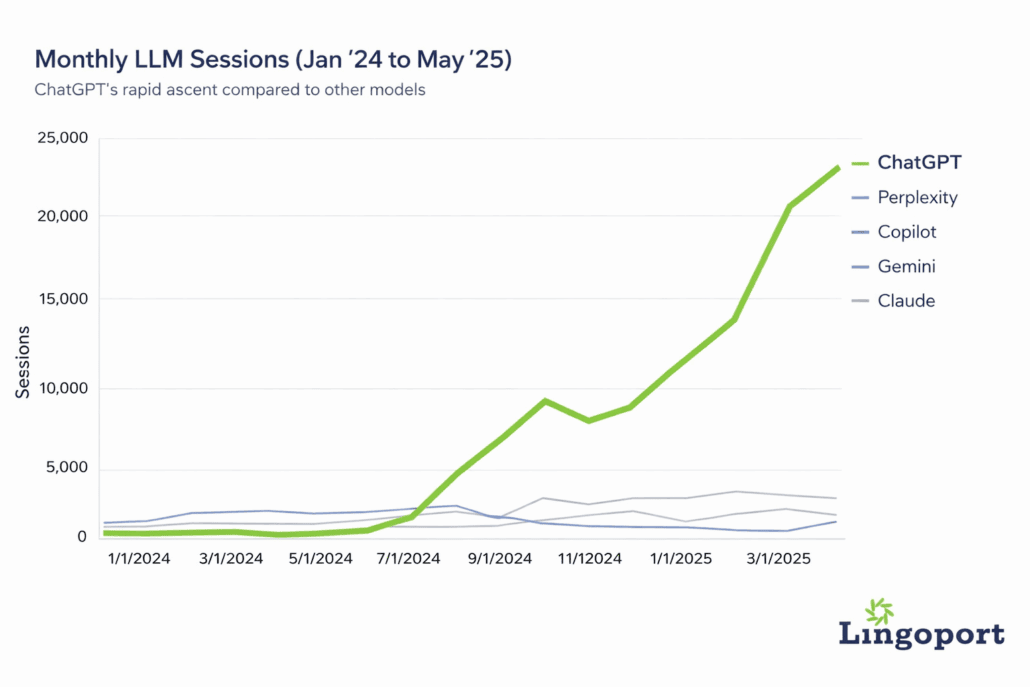
So, localized content must be clear, structured, and easy for machines to understand — not just optimized for keywords.
This connects localization closely with content strategy and SEO, especially for global SaaS companies.
What you can do right away:
Align localization, SEO, and content teams around shared goals and terminology.
Trend 7. Hybrid Localization Workflows Become the Norm
Pure automation is risky, but purely human workflows do not scale.
Most organizations now use hybrid workflows: AI handles volume and speed, while humans guide tone and review high-impact content.
What you can do right away:
Map your current workflow and mark where AI can help.
Trend 8. AI Competence Becomes a Core Skill for Localization Specialists
AI is already part of everyday localization work. What separates specialists in 2026 is how well they understand it.
AI makes mistakes.
It always strictly follows instructions, but sometimes misses the intent.
For localization specialists, this makes AI competence a professional requirement.
Being “AI-competent” means knowing when AI is reliable and when it needs corrections or review.
In 2026, localization specialists have to master this balance, otherwise, they will lose their jobs.
What you can start doing right away:
Study how AI behaves and what risks and limitations it has, using official documentation, courses, or YouTube videos. Work with real examples of AI errors, analyze why they happened, and define clear rules for when human review is required.
It can also be useful to watch selected talks from GenAI in Localization events, such as a session by Marina Pantcheva, where she explains how to recognize and fight so-called “AI slop,” including poor wording.
Trend 9. Prompt Engineering Enters Everyday Localization Work
Each company still needs to create style guides and terminology lists.
But prompts now shape how AI writes and translates. Very soon, prompt libraries will become a new language asset, just like glossaries.
What you can start doing right away:
Save, version, and share your best prompts with colleagues instead of rewriting them each time.
Trend 10. Concerns Are Growing Around AI and Localization
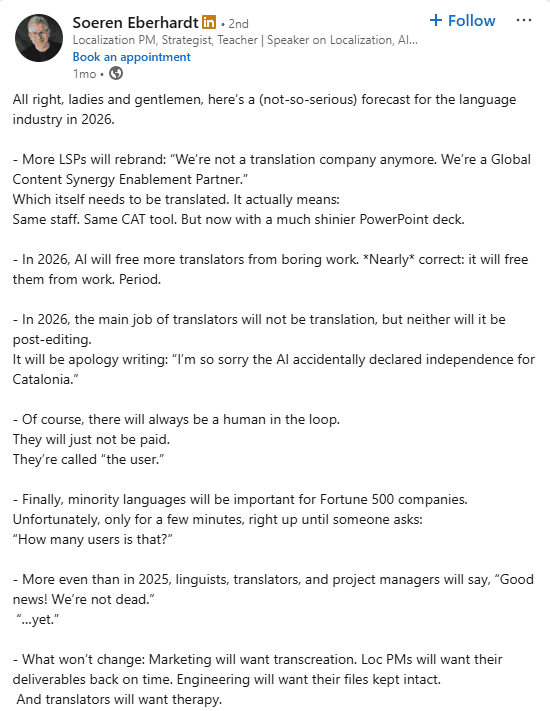
Although AI has brought a wave of optimism and inspiration to the localization industry, not everyone shares this enthusiasm. Alongside excitement, there is also concern, skepticism, and fatigue.
A viral LinkedIn post by Soeren Eberhardt captures this mood through irony and dark humor:
What to do right now
Don’t be over-optimistic about AI.
Keep critical thinking at the center of your work. Test outputs, question results, correct mistakes, and iterate — just as you would with any new tool introduced into a professional workflow.
AI can be powerful, but only when used consciously and responsibly.
Conclusion
In 2026, AI will continue to expand into new areas, simplifying localization and making it faster and more efficient. This does not mean there will be no place for humans. Instead, the human role will change — it will become more complex, responsible, and often more creative and interesting.
Also remember that AI should be used thoughtfully, balance matters. In 2026, those who adapt, think critically, and stay resilient will be best positioned as technology continues to reshape the industry.
As localization workflows evolve in 2026, not everything is changing. Some fundamentals remain stable, especially early localization involvement in software development. Localyzer from Lingoport supports safe and efficient localization from the very start of development. It removes manual file handling, gives translators real context, and helps teams catch issues early, reducing rework, delays, and localization costs while keeping localization in sync with development. Contact Lingoport today to schedule a demo and learn how it can help you streamline your software localization.